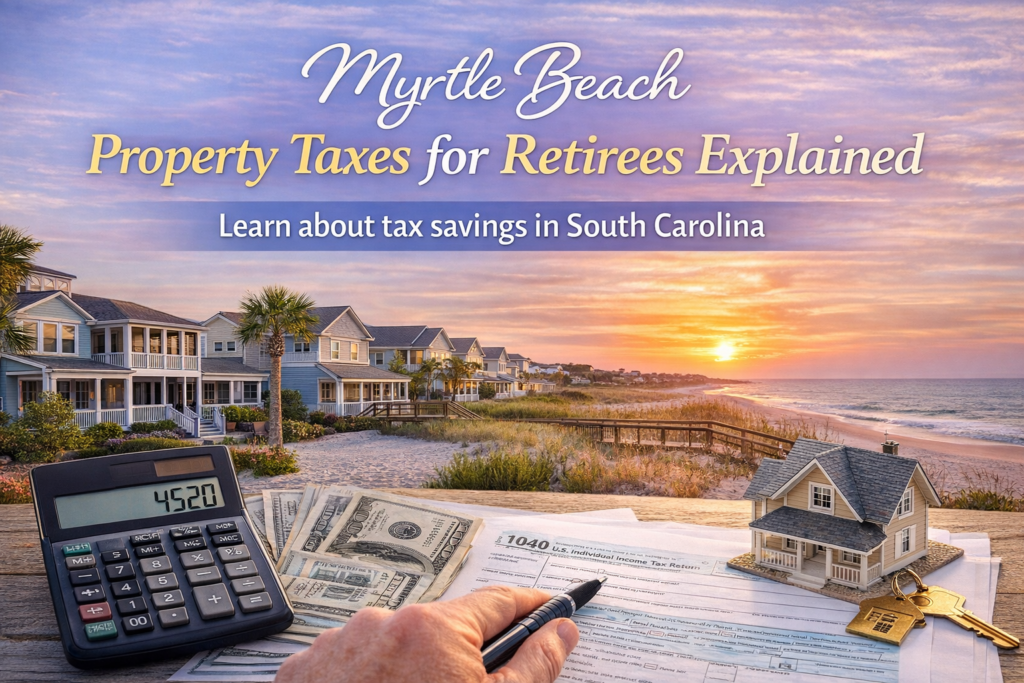
Retiring to South Carolina’s Grand Strand means enjoying sunny beaches, golf courses, and a lower cost of living. One of the biggest financial advantages for homeowners is the way property taxes are structured. Understanding Myrtle Beach property taxes for retirees can help you plan accurately and decide whether buying a home in a 55‑plus community is right for you. This article breaks down how property taxes are calculated, the special 4 percent assessment ratio for primary residences, the Homestead Exemption,n and how these policies apply to popular neighborhoods such as Cresswind, Seasons at Prince Creek, Spring Forest, Del Webb at Grande Dunes, and Lakeside Crossing.
South Carolina offers one of the lowest property tax burdens in the nation. The state’s Department of Revenue lists a 4 percent assessment ratio for primary residences, compared to a 6 percent ratio for other real estate. An example from Pickens County shows that two identical homes valued at $200,000 can have drastically different bills: a home taxed at 4 percent owed roughly $800 in property taxes, while an identical home taxed at 6 percent owed around $2,590.
To receive the lower rate, homeowners must apply with the county assessor and prove that the property is their legal primary residence. This application is usually a one‑time process, but you can only claim the 4 percent rate on one property at a time.
In addition to the lower assessment ratio, South Carolina offers a Homestead Exemption for homeowners aged 65 and older, as well as those who are totally and permanently disabled or legally blind. The state’s Department of Revenue describes this program as a complete exemption of taxes on the first $50,000 in fair market value of your legal residence. To qualify, you must:
Once granted, you do not need to reapply unless you move or the property changes ownership. For retirees, this exemption can further reduce property taxes by removing the first $50,000 of value from the taxable base.
While property taxes vary by county, the overall effective rate across South Carolina averages between 0.51 and 0.53 percent—well below many northern states. Myrtle Beach residents benefit even more: a popular 55places guide notes that property taxes in the area are among the lowest in the country and that homeowners can expect to pay 4 to 6 percent of the market value. In addition, residents can receive an 88 percent property tax credit according to the Myrtle Beach Area Chamber of Commerce. When combined with the Homestead Exemption, this can significantly reduce retirees’ annual tax bills.
Although the county sets property taxes, understanding how they affect specific retirement communities helps you plan your budget. Below is an overview of how the main tax policies relate to some well‑known neighborhoods in and around Myrtle Beach.
Cresswind is a modern 55‑plus community built between 2013 and 2022. Residents enjoy a 12,500‑square‑foot clubhouse, fitness center, resort‑style pool, tennis and pickleball courts, and numerous social clubs. Because this community is located within Horry County, homeowners who establish the property as their primary residence can apply for the 4 percent assessment ratio and the Homestead Exemption. New construction and high‑end amenities may increase fair market values, but the low assessment ratio helps keep annual taxes moderate.
This gated community features about 446 single‑family homes and a 29,000‑square‑foot clubhouse with indoor and outdoor pools, saunas, tennis courts, and walking trails. Like other Horry County homes, qualifying residents benefit from the 4 percent assessment ratio and Homestead Exemption. With property tax rates already low, retirees appreciate that Seasons provides resort‑style amenities without an outsized tax burden.
Spring Forest is a smaller neighborhood of roughly 126 single‑family homes, where the HOA covers lawn care, common-area maintenance, and RV/boat storage. Housing here is often more affordable than in newer communities, making the 4 percent assessment ratio especially valuable. Eligible homeowners aged 65 or older can further reduce their taxable value through the Homestead Exemption.
Del Webb at Grande Dunes offers luxury living with a resort clubhouse, pools, a fitness center, pickleball and tennis courts, a community garden, and access to the Grande Dunes Ocean Club. The homes range from two‑ to four‑bedroom designs and can be more expensive than homes in some other communities. Thanks to the 4 percent assessment ratio and the Homestead Exemption, many retirees still find their property taxes manageable. Qualifying veterans may also receive additional exemptions.
Located in Conway, Lakeside Crossing is an affordable 55‑plus manufactured‑home community with around 400 completed homes and more under development. Residents enjoy a clubhouse, fitness center, heated outdoor pool, hot tub, and lake access. The low property taxes in Horry County help make this community attractive to budget‑conscious retirees. Homeowners who make the community their primary residence can apply for the 4 percent assessment ratio and the Homestead Exemption to further reduce their tax bill.
If you are considering a move to Myrtle Beach or the surrounding area, keep the following tips in mind:
Myrtle Beach’s property tax structure is one of the reasons so many retirees choose to settle on the Grand Strand. The combination of a 4 percent assessment ratio for primary residences, a Homestead Exemption that excludes the first $50,000 of value, and an 88 percent city tax credit results in some of the lowest property taxes in the country. Whether you opt for a luxury community like Del Webb at Grande Dunes, a resort‑style enclave like Cresswind, or a budget‑friendly neighborhood such as Lakeside Crossing, understanding these policies helps you stretch your retirement dollars further.
Choosing the right home in Myrtle Beach involves more than comparing amenities and floor plans—it also requires a clear grasp of how property taxes will impact your budget. If you are ready to tour communities like Cresswind, Seasons at Prince Creek, Spring Forest, Del Webb at Grande Dunes, or Lakeside Crossing and learn more about their tax advantages, we’re here to guide you.